Lith Corporation, founded in 1998 by a group of material science doctor from Tsinghua University, has now become the leading manufacturer of battery lab&production equipment. Lith Corporation have production factories in shenzhen and xiamen of China.This allows for the possibility of providing high quality and low-cost precision machines for lab&production equipment,including: roller press, film coater,mixer, high-temperature furnace, glove box,and complete set of equipment for research of rechargeable battery materials. Simple to operate, low cost and commitment to our customers is our priority.
Atmosphere Sintering Furnace: Advanced Solutions for High-Precision Material Processing
Overview
An atmosphere sintering furnace is a highly specialized thermal processing equipment designed to heat materials to elevated temperatures in a controlled atmospheric environment. Unlike conventional furnaces that operate in ambient air, atmosphere sintering furnaces allow precise control over the gas composition inside the furnace chamber. This capability is essential for preventing oxidation, controlling chemical reactions, and achieving high-quality sintering of metals, ceramics, and composite materials. Widely used in advanced manufacturing industries, these furnaces ensure superior material properties and consistent product performance.
Features
Modern atmosphere sintering furnaces are equipped with advanced features that enhance both operational efficiency and product quality. Key features include:
Controlled Atmosphere: Users can choose from inert gases (such as argon or nitrogen), reducing gases (like hydrogen), or custom gas mixtures to suit specific material requirements.
High-Temperature Capability: Many models can reach temperatures up to 1700°C, enabling sintering of refractory metals and high-performance ceramics.
Uniform Heating: Multi-zone heating elements and optimized chamber design provide consistent temperature distribution, reducing internal stresses and ensuring uniform sintering.
Programmable Temperature Profiles: Advanced furnaces allow users to set precise temperature ramps, holding times, and cooling rates for repeatable and optimized processes.
Safety and Automation: Features such as over-temperature protection, gas flow monitoring, and automated control systems enhance operational safety and reduce manual intervention.
Sintering Process
The atmosphere sintering process involves several critical steps to achieve high-quality densification and material consolidation:
Loading: Components or powder compacts are placed into the furnace chamber. Careful arrangement ensures uniform heat exposure.
Atmosphere Adjustment: The furnace is purged with the selected gas to eliminate oxygen or moisture. Maintaining the desired atmosphere is critical for preventing oxidation and unwanted reactions.
Heating: The furnace temperature is gradually increased according to a programmed profile. Controlled ramp rates prevent thermal shock and warping.
Soaking/Sintering: The materials are held at the target temperature to allow diffusion, particle bonding, and densification. The controlled atmosphere ensures chemical integrity.
Cooling: The furnace cools the materials at a programmed rate to achieve the desired microstructure and mechanical properties. Cooling can also occur in a controlled atmosphere to avoid oxidation.
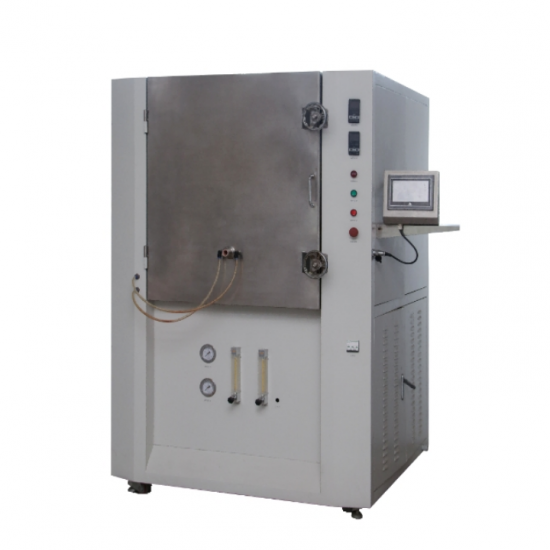
Microwave Sintering Furnace
Applications
Atmosphere sintering furnaces are indispensable in a wide range of industries where material performance is critical. Key applications include:
Metal Powder Processing: Sintering of stainless steel, titanium, and superalloy powders for aerospace, automotive, and tooling applications.
Ceramic Manufacturing: Production of advanced ceramics such as alumina, zirconia, and silicon carbide used in electronics, medical devices, and engineering components.
Fuel Cell Components: Sintering of solid oxide fuel cell (SOFC) components, including electrodes and electrolyte layers, requiring precise microstructure control.
Additive Manufacturing: Post-processing of 3D-printed metal or ceramic parts to improve density, strength, and surface quality.
Magnetic Materials: Fabrication of ferrites and other magnetic materials for electronics, motors, and transformers.
Advantages
Using an atmosphere sintering furnace offers several significant advantages over conventional sintering methods:
Enhanced Material Properties: Controlled atmospheres prevent oxidation and contamination, leading to higher strength, hardness, and electrical or thermal conductivity.
Process Repeatability: Programmable temperature profiles and gas control enable consistent results for batch and continuous production.
Flexibility: The ability to adjust temperature, gas composition, and heating rates allows sintering of diverse materials, from metals to advanced ceramics.
Energy Efficiency: Modern furnaces feature high-efficiency insulation and optimized heating zones, reducing energy consumption while maintaining performance.
Reduced Defects: Uniform heating and controlled cooling minimize warping, cracking, and internal stresses, improving yield and product reliability.
Conclusion
An atmosphere sintering furnace is a versatile and essential tool for high-precision material processing. Its ability to control temperature, atmosphere, and heating profiles ensures superior material quality, reliability, and performance. From advanced ceramics and metal powders to fuel cells and additive manufacturing, these furnaces play a pivotal role in modern industrial and research applications, delivering consistent results and maximizing production efficiency.


 +86 13174506016
 Louis@lithmachine.com
 +86 18559646958
 18659217588
 English ▼


